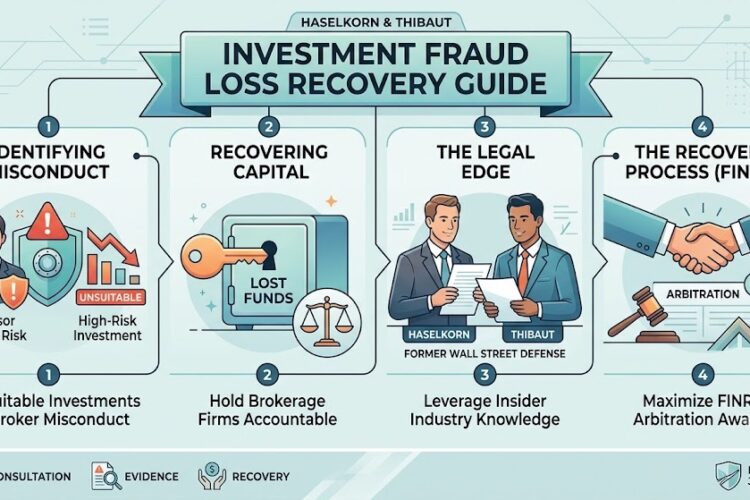
Recover investment losses with Haselkorn & Thibaut. Former Wall Street defense attorneys fighting broker fraud, unsuitability, and misconduct nationwide.
Discovering that your hard-earned life savings or retirement funds vanished due to questionable financial advice is a jarring experience. Many investors mistakenly believe that portfolio drops are simply the result of natural market downturns. However, when financial advisors breach their fiduciary duties, recommend high-risk private placements, or engage in excessive trading, those losses stem from broker misconduct—not market fluctuations. Partnering with seasoned legal counsel like Haselkorn & Thibaut gives defrauded investors a decisive edge in holding brokerage firms accountable through Financial Industry Regulatory Authority (FINRA) arbitration.
Quick Answer
Investors who suffer severe financial losses from broker misconduct or misleading investment advice can recover capital by filing a FINRA arbitration claim. Working with specialized securities fraud attorneys—particularly former Wall Street defense counsel—ensures rigorous evidence gathering, proper damages calculation, and aggressive advocacy to restore lost retirement and trust funds on a contingency fee basis.
What is Haselkorn & Thibaut?
Haselkorn & Thibaut, P.A. (operating as Investment Fraud Lawyers) is a boutique national securities arbitration and litigation law firm specializing exclusively in helping individual investors, trusts, and institutions recover investment losses caused by broker-dealer misconduct, financial advisor fraud, and breach of fiduciary duty. Founded by former Wall Street defense attorneys Jason S. Haselkorn and Matthew N. Thibaut, the firm maintains a 98% success rate across hundreds of FINRA arbitrations and has handled over $520 million in securities matters nationwide.
Understanding Investment Fraud & Broker Misconduct
When an individual hands over their capital to a wealth manager or stockbroker, that professional is bound by strict industry rules set by the Securities and Exchange Commission (SEC) and FINRA. Financial advisors must recommend investments that align with the client’s unique financial profile, risk tolerance, age, liquid net worth, and investment objectives (FINRA Rule 2111 – Suitability).
Investment fraud occurs when an advisor intentionally misrepresents facts, conceals risks, trades without authorization, or places their own commission gains above the client’s financial well-being.
Key Rule Insight: Under FINRA Rule 2111 and the SEC’s Regulation Best Interest (Reg BI), broker-dealers and registered representatives must act in the client’s best interest at the time of a recommendation, eliminating conflicts of interest that prioritize firm revenue over investor safety.
Summary Box: Core Concepts of Securities Misconduct
- Suitability Violation: Recommending complex or volatile products (like non-traded REITs or structured notes) to conservative retirees.
- Broker-Dealer Supervision: Firms are legally obligated under FINRA Rule 3110 to monitor their advisors’ activities.
- Recovery Mechanism: Most investor claims bypass public court systems and are resolved through binding FINRA arbitration.
The Wall Street Defense Advantage
Not all securities attorneys approach investor claims from the same angle. A primary differentiator for top-tier law firms is insider knowledge of how brokerage firms operate, conceal errors, and structure their legal defense strategies.
Having spent years representing major Wall Street institutions, former defense attorneys understand the specific metrics, compliance red flags, and internal auditing logs that brokerage firms attempt to obscure during discovery.
Wall Street Defense Experience
       │
       ▼
Deconstruct Defense Tactics ──► Identify Internal Compliance Failures ──► Maximize FINRA Award
When evaluating a potential claim, attorneys who previously defended brokerage houses know exactly how compliance officers evaluate risk, how defense lawyers try to blame “market volatility,” and where firms fail in their supervisory obligations. This experience translates into precise legal claims, accurate damage quantification, and higher settlement leverage during mediation.
Primary Categories of Financial Advisor Misconduct
Broker misconduct manifests in several distinct ways. Recognizing these warning signs early can save investors from catastrophic capital depletion.
                    ┌─────────────────────────────────────────┐
                    │ Types of Investment Fraud & Misconduct │
                    └────────────────────┬────────────────────┘
                                         │
    ┌────────────────────┬───────────────┴───────────────┬────────────────────┐
    ▼                    ▼                               ▼                    ▼
Unsuitable Recommendations  Churning / Overtrading     Private Placement Fraud  Elder Financial Exploitation
(High-Risk REITs/Notes)     (Excessive Commissions)    (Illiquid/Ponzi Schemes) (Targeting Vulnerable Seniors)
1. Unsuitable Investment Recommendations
Financial advisors frequently push high-yield, complex illiquid products—such as Non-Traded Real Estate Investment Trusts (REITs), Delaware Statutary Trusts (DSTs), or Structured Notes—because they carry upfront commissions ranging from 6% to 10%. These products are inherently unsuitable for investors needing liquidity or preservation of capital.
2. Churning & Excessive Trading
Churning occurs when a broker executes frequent trades in a client’s account not to advance the client’s goals, but to generate trading commissions and markup fees. Indicators of churning include a high Turnover Rate (exceeding 6.0) and a high Cost-to-Equity Ratio (where an account must gain 20%+ annually just to break even after fees).
3. Misrepresentation and Omissions
Advisors are required to disclose all material risks before a client agrees to a transaction. Downplaying the risk of principal loss, promising guaranteed returns, or hiding fee structures constitutes fraudulent misrepresentation.
4. Elder Financial Abuse
Retirees and senior citizens are frequent targets of predatory investment schemes. Unscrupulous advisors often alter risk profiles, convince seniors to surrender fixed annuities with heavy surrender charges, or move funds into private placement Ponzi-like schemes.
Summary Box: Warning Signs of Advisor Misconduct
- Account statements showing unexplained frequent trading activity.
- Inability to liquidate or withdraw funds from private products.
- Dramatic discrepancies between your stated low-risk tolerance and high-risk investments.
- Sudden change in your risk profile on annual brokerage account review forms.
The FINRA Arbitration Process: Step-by-Step
Virtually every new brokerage account agreement contains a pre-dispute arbitration clause. This clause waives the investor’s right to sue in court before a jury, requiring disputes to be resolved through FINRA Dispute Resolution Services.
1.Initial Case Review & Forensic Audit: Weeks 1–3.
Securities attorneys examine monthly brokerage statements, trade confirmations, risk disclosures, and CRM records to calculate out-of-pocket net losses and well-managed portfolio benchmarks.
2.Filing the Statement of Claim: Month 1.
A formal Statement of Claim is submitted to FINRA detailing the factual narrative, legal causes of action (e.g., breach of fiduciary duty, failure to supervise, unsuitability), and the exact dollar recovery sought.
3.Arbitrator Selection & Discovery: Months 2–5.
Both parties select neutral arbitrators from FINRA lists. Attorneys exchange relevant documents under FINRA’s Discovery Guide, including internal firm emails, exception reports, and notes.
4.Mediation (Optional Settlement): Months 6–8.
A neutral mediator assists the parties in reaching a voluntary financial settlement. Many cases resolve here at a fraction of the cost and time of a full hearing.
5.Final Arbitration Hearing & Award: Months 9–14.
If unsettled, the case proceeds to a formal hearing where attorneys present witness testimony, cross-examine brokers, submit expert economic testimony, and obtain a final, binding award.
Community Insights: What Investors Get Wrong on Reddit & Quora
Analysis of investor discussions across forums like Reddit (r/investing, r/personalfinance, r/legaladvice) and Quora reveals widespread misunderstandings regarding loss recovery.
1. Myth: “I signed a risk disclosure, so I can’t recover my losses.”
- Reality: Signing a form acknowledging market risk does not give a broker license to commit fraud, misrepresent product structures, or recommend investments unaligned with your profile. Standard disclosures do not insulate brokerage firms from liability due to negligence or unsuitable advice.
2. Myth: “Losses are just bad luck due to market conditions.”
- Reality: If a market index drops 5% while your conservative portfolio plummets 35% due to concentrated, unhedged positions in private REITs or illiquid notes, your loss is likely due to improper asset allocation and broker negligence.
3. Myth: “Hiring a legal team is too expensive.”
- Reality: Premier securities fraud law firms work on a contingency fee basis. Investors pay zero upfront costs and zero attorney fees unless a monetary recovery is secured.
Side-by-Side Comparisons
FINRA Arbitration vs. Traditional Court Litigation
| Feature | FINRA Arbitration | Traditional Court Litigation |
| Time to Resolution | 12 to 16 Months (Faster) | 2 to 5 Years (Slower) |
| Decision Maker | Panel of 1 to 3 Neutral Arbitrators | Judge and Civilian Jury |
| Public Visibility | Private filings; public final awards | Public record filings & courtrooms |
| Appeals Process | Final & Binding (Extremely limited appeal) | Lengthy multi-tier appeal options |
| Cost & Overhead | Significantly lower discovery costs | High legal expenses & lengthy motion practice |
Working with Specialized Securities Counsel vs. General Litigation Lawyers
| Attribute | Specialized Securities Fraud Firm | General Personal Injury / Practice Lawyer |
| Focus | 100% Securities Law & FINRA Arbitration | Broad legal coverage (Divorce, Auto Accidents) |
| Defense Knowledge | Former Wall Street defense perspective | Standard plaintiff perspective |
| Damages Calculation | In-house forensic economic models | Subcontracted external financial vendors |
| FINRA Familiarity | Daily navigation of FINRA Rules & Panels | Occasional or first-time FINRA filings |
Summary Box: Key Legal Rules to Know
- FINRA Rule 2111 (Suitability): Requires brokers to have a reasonable basis to believe a recommendation is suitable based on the customer’s investment profile.
- FINRA Rule 3110 (Supervision): Mandates that firms establish and maintain a supervisory system to ensure broker compliance.
- Six-Year Eligibility Rule (FINRA Rule 12206): Claims must be brought within 6 years from the event giving rise to the dispute. Acting immediately preserves crucial records.
People Also Ask (PAA)
Can I recover investment losses if I signed an agreement acknowledging risk?
Yes. Signing a standard risk disclosure or account application does not waive your rights if your financial advisor lied about the risks, recommended an unsuitable product, or engaged in unapproved trading.
How long do I have to file a FINRA arbitration claim?
Under FINRA Rule 12206, no claim is eligible for arbitration where six years have elapsed from the event giving rise to the claim. However, state statutes of limitations may impose shorter deadlines (often 2 to 4 years from discovery of fraud), making immediate legal review vital.
How much does it cost to hire an investment fraud attorney?
Most specialized investment fraud lawyers handle cases on a contingency fee structure. This means there are no upfront costs or hourly fees; legal fees are deducted only as an agreed-upon percentage of the funds successfully recovered.
What is the average settlement in a FINRA arbitration case?
Settlements and awards vary depending on net out-of-pocket losses, the degree of broker egregious misconduct, and available insurance or firm capital. Cases can range from tens of thousands of dollars to multi-million-dollar recoveries.
How do I know if my advisor committed fraud or if I just lost money in the market?
If your losses significantly exceed overall market benchmarks, if you were placed in products you did not understand, or if your advisor traded without your consent or refused to process redemptions, misconduct is likely involved. A legal expert can perform a forensic audit of your account statements.
Frequently Asked Questions (FAQs)
What is the difference between a broker-dealer and a Registered Investment Advisor (RIA)?
Broker-dealers buy and sell securities on behalf of clients or their own accounts and are historically governed by the suitability standard (and now Reg BI) through FINRA supervision. Registered Investment Advisors (RIAs) provide ongoing management and are held to a strict legal fiduciary duty under the Investment Advisers Act of 1940, regulated directly by the SEC or state regulators. Both standards require advisors to prioritize investor interests, and breaches of these duties form the basis for financial loss recovery claims.
What types of investments frequently lead to fraud or suitability claims?
High-risk financial products with lucrative broker commissions are common drivers of investor loss claims. Examples include Non-Traded REITs, Delaware Statutory Trusts (DSTs), Private Placements under Regulation D, Structured Notes, Oil and Gas Partnerships, Variable Annuities with heavy surrender fees, and Leveraged ETFs. These products often suffer from illiquidity, opaque valuation, extreme volatility, or complete structural collapse.
What should I do immediately if I suspect financial advisor misconduct?
First, gather all monthly account statements, trade confirmations, promotional brochures, prospectus copies, and emails or texts with your advisor. Second, avoid closing accounts or confronting the broker before speaking with legal counsel, as brokers may alter notes or records. Third, obtain a free case evaluation from a specialized securities fraud attorney who can pull FINRA BrokerCheck reports and conduct a net-loss calculation.
Can I pursue a claim if the brokerage firm or broker has gone out of business?
Yes, depending on the circumstances. While pursuing an individual broker who has declared bankruptcy can be challenging, brokerage firms are typically required to maintain minimum net capital standards and carry Errors & Omissions (E&O) insurance. Additionally, clearing firms or supervisor entities may bear secondary legal liability for failing to detect ongoing fraud schemes.
What is “Failure to Supervise” in FINRA claims?
Under FINRA Rule 3110, brokerage firms must establish and maintain a written supervisory system to oversee their representatives’ activities. If an advisor engages in unauthorized trading, conversion of funds, or selling unapproved investments (“selling away”), the firm can be held liable for failing to implement reasonable compliance controls, monitoring tools, or exception reports that would have caught the misconduct.
How are damages calculated in investment fraud cases?
Damages in FINRA arbitration are calculated using several methodologies. The primary measure is Net Out-of-Pocket Losses (total money invested minus withdrawals and remaining value). Claimants may also seek Well-Managed Portfolio Damages (what the funds would have earned had they been invested in an appropriate conservative benchmark, like an S&P 500 or bond index), along with statutory interest, attorney fees, and administrative costs.